5. (24 pts) Members of the giant algal genus, Nitella, exhibit a transmembrane potential of approximately -140 mV. If stimulated in an appropriate manner - electrically or by bending the long, narrow cell - the membrane potential changes as indicated in the figure below (where the arrow indicates the stimulus application). The ambient temperature is 18 oC
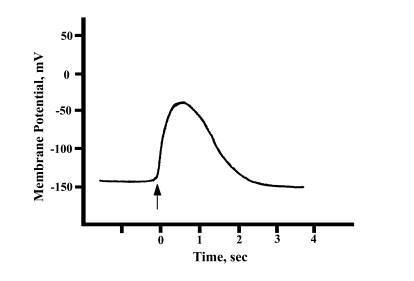
The organism is commonly found in fresh-water ponds and streams, and one determination of the cytoplasmic and environmental concentration of the major ions yielded the following data:
|
Compartment |
Na+ |
K+ |
Cl- |
|
Cytoplasm |
14.0 mM |
119.0 mM |
65.0 mM |
|
Stream |
1.0 |
0.1 |
1.2 |
Given your understanding of membrane potentials in other cells, answer all the following questions. (Note: the log of 1/14 is -1.15, of 14/1= 1.15; of 0.1/119 is -3.08, of 119/0.1 = 3.08; and of 1.2/65 is -1.7. of 65/1.2 = 1.7.)
A. (6 pts) how might these ion gradients be established and maintained?
B. (6 pts) How might the "resting" membrane potential arise?
C. (6 pts) How might the "action" potential be generated?
D. (6 pts) Propose a test for one of your hypotheses (in A., B. or C.) and indicate clearly what the results would show.
