3. (30 pts) The cDNA of a gene coding for an interesting membrane protein has been cloned, amplified and sequenced, and the amino acid sequence of its probable translation product inferred from the nucleotide sequence. The protein contains 240 amino acids and exhibits an apparent molecular weight in SDS-PAGE of approximately 30 kDa. A hydropathy plot of the protein’s primary structure is presented in the figure below, numbering the amino acids from the amino terminal end to the carboxy terminal as is customary (designated "N" and "C" respectively).
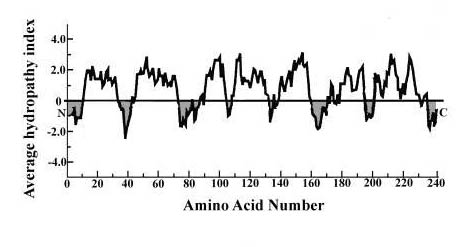
Consider these data and answer all the following questions:
A. (3 pts) Why is the protein likely to be
an IMP?
B. (4 pts) How many times does this IMP
span the membrane? Briefly discuss the basis
for your answer.
C. (4 pts) If a reagent for detecting the
amino terminus labeled all of this protein in intact cells (and no additional
protein was labeled in leaky cells or ghosts), where is the carboxy terminus likely
located? In the cytoplasm or in the
extracellular space? Why?
D. (3 pts) What is the likely secondary
structure of protein in those regions spanning the membrane?
E. (4 pts) Two of the several hydrophobic
regions of the protein each contain 2 clusters of polar amino acids; each of these
clusters contains 1 or 2 polar amino acids. Using
4 arrows indicate the likely locations of these clusters in the figure above.
F. (8 pts) Assuming these polar clusters
are functionally important, hypothesize a likely function for the protein, draw a
reasonable 3-D model for its membrane organization in the space below,
and briefly discuss how the organization is related to its function.
G. (5 pts) How would you test your hypothesis concerning its function and what would the results show?
